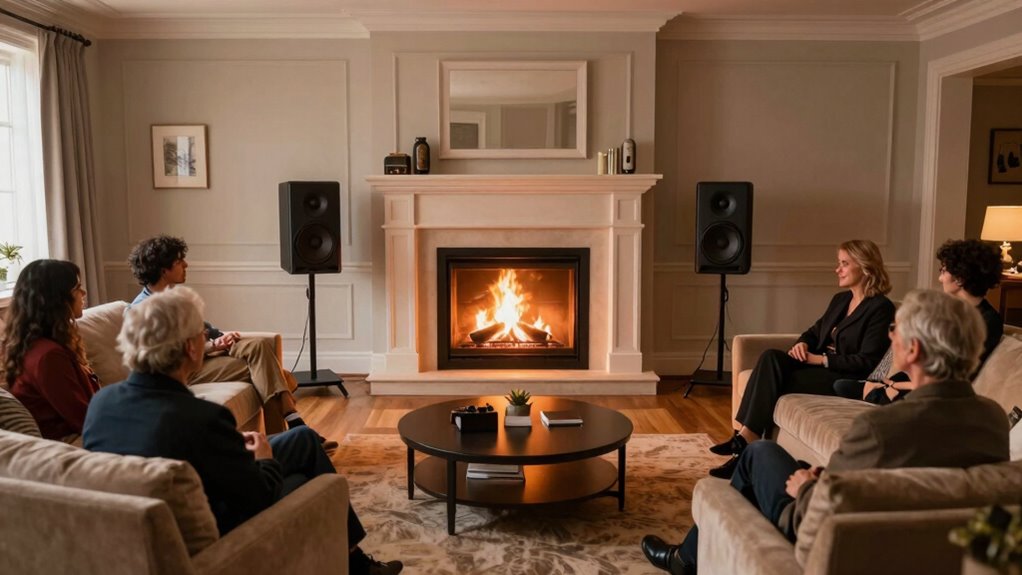

To place speakers for a room full of guests, position them along shorter walls to reduce sound reflections and avoid placing them behind furniture or in corners to prevent muddy sound. Make sure speakers are at ear level and angled toward the seating area for clear audio. Keep speakers symmetrical and equidistant from the main seating zone to create a balanced soundscape. To learn more about optimizing sound quality, explore the key principles of speaker placement and room acoustics.
Key Takeaways
- Position speakers along shorter walls to minimize reflections and prevent sound bouncing off surfaces.
- Place speakers at ear level and angle them toward the main seating area for clear sound.
- Avoid placing speakers behind furniture or in corners to prevent muddy sound and dead spots.
- Ensure speakers are symmetrically arranged for balanced stereo imaging and immersive sound.
- Use sound-absorbing materials and adjust placement based on room acoustics to enhance clarity.
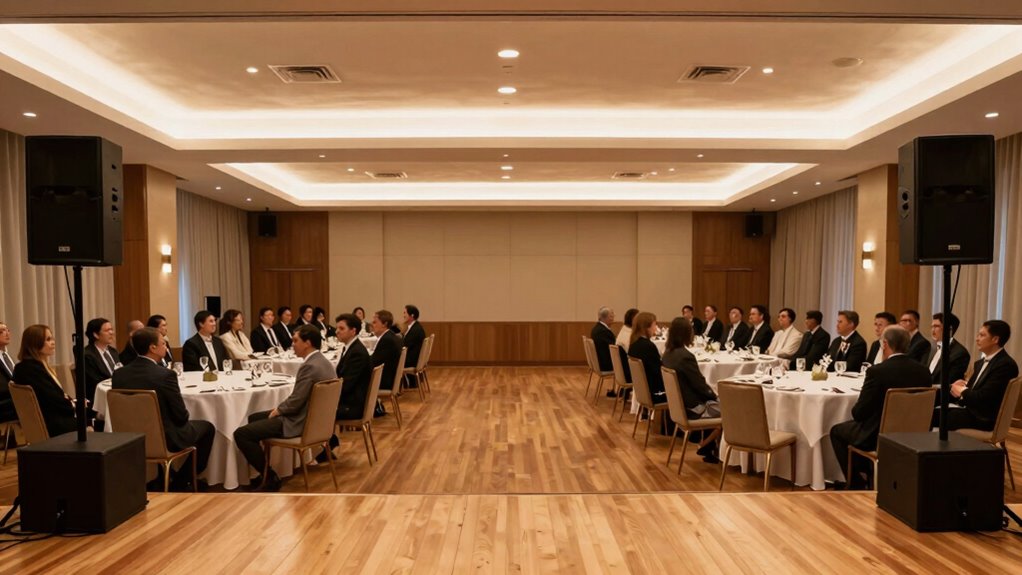
When hosting a room full of guests, the way you position your speakers can make all the difference in delivering clear, balanced sound throughout the space. Good speaker placement is crucial for achieving ideal sound quality, ensuring everyone hears the music or announcements clearly without distortion or dead spots. To start, consider the shape and size of your room. Large, rectangular spaces often require more strategic placement to prevent sound from bouncing off walls and creating echoes. Position your speakers along the shorter walls if possible, which helps minimize sound reflections and creates a more direct sound path.
Position speakers along shorter walls to reduce echoes and improve sound clarity throughout the room.
Next, think about the height and angle of your speakers. Placing them at ear level when guests are seated maximizes sound clarity. If you’re using floor-standing speakers, angle them slightly toward the main listening area. For wall-mounted or bookshelf speakers, aim them so that the sound projects directly into the room’s center. Proper speaker placement reduces sound dispersion issues, ensuring that sound quality remains consistent no matter where your guests are seated. Avoid placing speakers behind furniture or near corners, as these positions can muddy the sound and cause uneven volume levels.
Another key factor in speaker placement is maintaining symmetry. Set up your speakers equidistant from the main seating area to create a balanced stereo image. This helps prevent one side from sounding louder or clearer than the other. If you’re working with multiple speakers, such as a surround sound system, ensure they’re positioned to create an immersive experience, with front speakers aligned with the screen and rear speakers behind the seating area. This setup not only enhances sound quality but also provides a more engaging atmosphere for your guests. Additionally, room acoustics can significantly impact sound clarity, so adjusting your setup accordingly will yield the best results. You can also consider using sound-absorbing materials to better control reflections and improve overall audio quality. Experimenting with different placements and understanding sound reflection principles can help you achieve the best sound quality. A little effort in positioning your speakers can transform the entire room into a lively, well-balanced sound space, making your hosting experience that much better for everyone.

Acoustic Audio AA321B Mountable Indoor Speakers 400 Watts Black Bookshelf Pair
- Mountable Indoor Speakers: Wired passive design for easy setup
- High-Quality Sound: Full range with 2.5" polypropylene woofers
- Wide Frequency Response: 150Hz-20kHz with 88dB sensitivity
As an affiliate, we earn on qualifying purchases.
As an affiliate, we earn on qualifying purchases.
Frequently Asked Questions
What Types of Speakers Are Best for Large Gatherings?
For large gatherings, choose powerful, high-quality speakers like line arrays or column speakers that can project sound evenly across the room. You should calibrate the speakers for ideal sound, ensuring clear audio for everyone. Incorporate acoustic treatment to reduce echoes and improve clarity. Proper speaker calibration and strategic placement, combined with acoustic treatment, help guarantee your guests experience balanced, immersive sound no matter where they’re seated.
How Do I Prevent Feedback From the Speakers?
Did you know that feedback can occur in over 70% of live sound setups? To prevent it, focus on proper microphone placement—keep mics away from speakers—and use echo cancellation technology. Position your microphones close to speakers, but avoid pointing them directly at the sound source. Adjust speaker angles and volume levels carefully, and consider using feedback suppressors to eliminate unwanted squeals, ensuring clear sound for your guests.
Is Wireless or Wired Speaker Setup Better?
Wireless setups offer you unmatched convenience, allowing easy placement and fewer cables, which is great for dynamic spaces. However, wired speakers provide wired reliability, ensuring consistent sound quality without interference. If you prioritize flexibility and quick setup, go wireless. But if you want stability and minimal signal issues, wired speakers are your best choice. Consider your venue’s needs and your technical comfort to decide which setup suits you best.
How Do I Balance Sound Levels Across the Room?
Balancing sound levels in a room is like tuning a musical instrument—you want harmony everywhere. Start by adjusting your speakers to minimize sound absorption issues, ensuring no area is overly muffled or echoey. Use acoustic treatment, like panels or rugs, to even out sound reflections. Test with a guest moving around, then fine-tune your speaker volume and placement. This creates a seamless, balanced sound experience, no matter where your guests are.
What’s the Ideal Speaker Placement for Outdoor Events?
For outdoor events, position your speakers so sound reflection minimizes echoes and enhances clarity. Place them at a height slightly above head level to project sound evenly across the area, avoiding dead spots. Keep speakers angled toward the audience, not the sky or nearby reflective surfaces. This setup guarantees clear sound, maintains volume, and creates an engaging experience, even for larger crowds. Adjust as needed based on the environment for the best results.
Conclusion
Remember, proper speaker placement can transform your gathering into an unforgettable experience. Don’t let worries about perfect acoustics hold you back—what truly matters is creating an inviting atmosphere where everyone feels engaged. Even if the setup isn’t flawless, your effort shows you care. Your guests will appreciate the warmth and energy you bring, making your event memorable long after the last song fades. Trust your instincts—you’ve got this!