
To match speakers to your projector room, consider the room’s size, shape, and acoustics first. Place speakers away from walls and reflect surfaces to avoid muddled sound. Use acoustic treatments like curtains or panels to control reflections. Choose speakers with suitable power ratings and wide dispersion for your space, and add a subwoofer if needed for deep bass. Properly integrated equipment makes a big difference; keep exploring to learn how to optimize your setup even further.
Key Takeaways
- Assess room size and shape to determine appropriate speaker power and dispersion needs.
- Position speakers away from walls and reflective surfaces to reduce sound distortion.
- Use acoustic treatments like panels and curtains to control reflections and improve clarity.
- Match speaker frequency response and power capacity to room acoustics for balanced sound.
- Focus on room-specific acoustics and placement to create an immersive audio-visual experience.
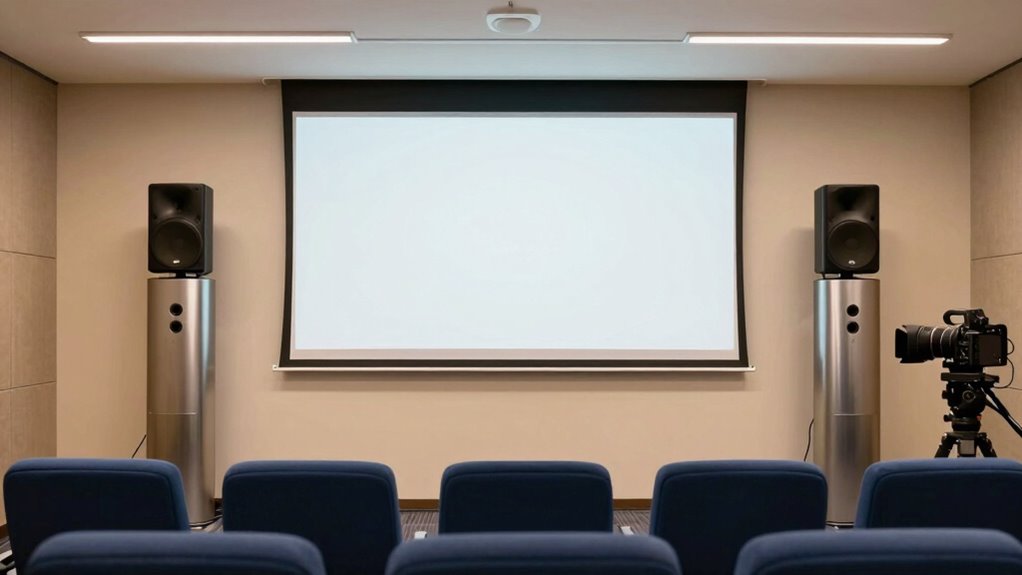
Have you ever wondered how to guarantee your sound system perfectly complements your projector room? It all starts with understanding that the right speakers can substantially enhance your viewing experience, but only if they’re matched properly to the space. To achieve ideal sound quality, you need to consider how your room’s acoustics influence audio performance. Room acoustics involve how sound waves interact with the space — reflecting, absorbing, or diffusing — which impacts clarity and balance. Ignoring this can lead to muddled sound, where dialogue and effects lose their sharpness. So, focusing on the acoustics helps you select speakers that deliver clear, immersive audio without unwanted echoes or dead spots.
Understanding your room’s acoustics ensures your speakers deliver clear, immersive sound for the ultimate viewing experience.
First, you want to evaluate the size and shape of your projector room. Larger rooms require more powerful speakers that can fill the space without distortion, while smaller rooms benefit from compact models that don’t overpower the environment. The shape of the room influences how sound bounces around; irregular shapes can scatter sound waves, creating uneven audio. In such cases, choosing speakers with good dispersion properties becomes essential to maintain consistent sound coverage. Conversely, rectangular or square rooms often have predictable reflections, allowing you to position speakers more effectively for balanced sound.
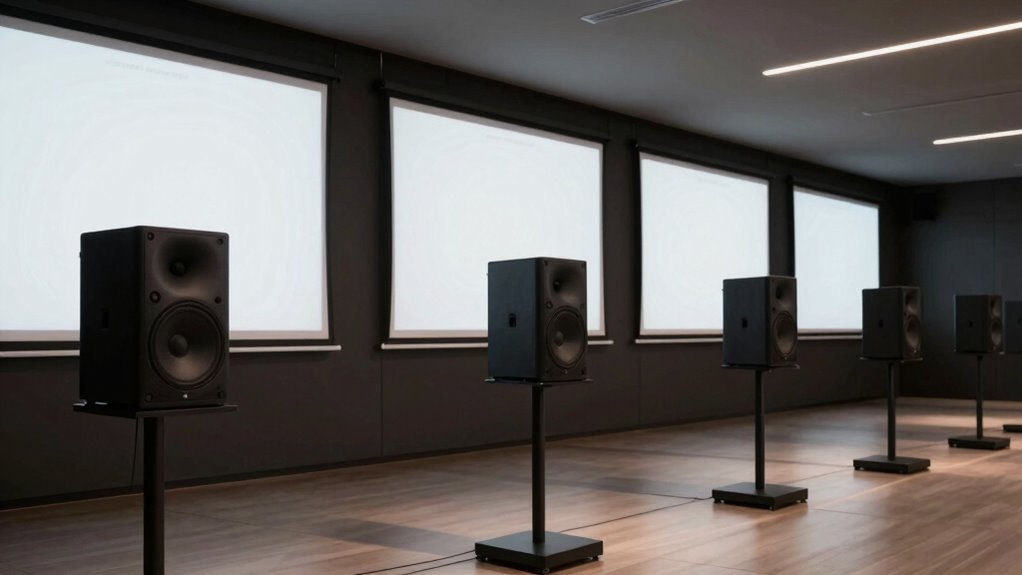
Placement is key. To achieve the best sound quality, position your speakers to minimize sound reflections from walls, ceilings, or furniture. For example, placing speakers slightly away from walls prevents bass buildup and echo, ensuring dialogue remains clear. Consider using acoustic treatments like rugs, curtains, or acoustic panels that absorb excess sound reflections, helping your speakers perform at their best. This can be especially crucial if your room has hard surfaces that tend to bounce sound waves. Additionally, understanding room acoustics can guide you in optimizing your speaker placement to reduce unwanted sound interactions. Being aware of room acoustics also allows you to select appropriate speaker types that suit your specific environment. Incorporating sound absorption techniques can further improve audio quality by controlling reverberation and echoes.
When selecting speakers, think about their frequency response and power handling. Your goal is to match their capabilities with the room’s acoustics so that highs, mids, and lows come through crisply without distortion. High-quality speakers with wider frequency responses will better reproduce the full spectrum of audio, from subtle whispers to thunderous explosions. Additionally, integrating a subwoofer can enhance bass response, filling in low frequencies that smaller speakers might struggle to deliver in larger spaces.
In essence, matching speakers to your projector room isn’t just about picking the most expensive model. It’s about understanding your space’s unique acoustic characteristics and choosing equipment that complements them. When you focus on sound quality and room acoustics, you’ll create an immersive environment where every sound detail enhances your visual experience, making your projector room truly exceptional.

HAPPRUN Native 1080P Projector, Bluetooth Home Theater Movie Projector with Built-in Speaker, Compatible with Smartphone, HDMI, Fire Stick, PS5, Indoor & Outdoor Use – Without Google TV System
- Native 1080P Resolution: 1920×1080 full HD visuals
- Compact and Portable: Fits in backpacks for outdoor use
- Bluetooth 5.1 Connectivity: Pair with speakers or headphones
As an affiliate, we earn on qualifying purchases.
As an affiliate, we earn on qualifying purchases.
Frequently Asked Questions
What Is the Ideal Speaker Wattage for Small Rooms?
For small rooms, an ideal speaker wattage ranges between 50 to 100 watts. You should focus on proper speaker placement to guarantee even sound distribution and avoid dead spots. Power calibration is essential—start with lower wattage and gradually increase while listening for clarity and distortion. This approach helps prevent damage and optimizes audio quality, making your small room sound clear and balanced without overpowering the space.
How Do Ambient Noise Levels Affect Speaker Selection?
Did you know that ambient noise levels can reduce speech intelligibility by up to 50%? When selecting speakers, consider ambient noise and how soundproofing techniques or acoustic treatment can improve audio clarity. Higher noise levels demand more powerful speakers or better soundproofing to prevent audio from getting lost. Proper acoustic treatment minimizes echo and background noise, ensuring your speakers deliver clear sound regardless of ambient noise, creating an effective and comfortable environment.
Can Portable Speakers Be Used for Permanent Setups?
Yes, portable speakers can be used for permanent setups, but you need to take wireless connectivity and speaker placement into account carefully. Make sure they have reliable wireless options like Bluetooth or Wi-Fi for seamless operation. Proper speaker placement is essential to optimize sound distribution and avoid clutter. While portable speakers offer flexibility, investing in fixed, professionally installed speakers might be better for long-term, high-quality audio performance in permanent rooms.
What Safety Considerations Are There for In-Ceiling Speakers?
When installing in-ceiling speakers, you should follow installation guidelines carefully to prevent safety hazards. Make certain the electrical wiring is properly insulated and securely connected to avoid shorts or fire risks. Avoid installing speakers in areas with high humidity or water exposure, which can cause damage and safety issues. Also, verify the speakers are mounted securely to prevent falling, and always turn off power before installation to minimize electrical hazards.
How Often Should Speaker Systems Be Maintained?
You should inspect your speaker systems at least twice a year to guarantee peak performance. During maintenance, check speaker placement to confirm they’re correctly positioned for sound quality, and review cable management to prevent damage or interference. Regular cleaning and testing help identify issues early, extending the lifespan of your system. Staying proactive keeps your audio clear and reliable, making sure your setup always delivers the best sound experience.
Conclusion
So, now that you’re armed with the secrets of matching speakers to projector rooms, go forth and conquer your sound setup! Remember, if your audience leaves with ringing ears or confused glances, it’s probably your fault. Don’t worry—perfect sound is just a few tweaks away. After all, who knew that choosing the right speakers could be the difference between a blockbuster presentation and a silent film? Happy listening!