Choosing the right baseball pitching machine depends heavily on whether you need realistic game-speed pitches for advanced hitters or slower, consistent tosses for young beginners. My top recommendation for most serious players is the Heater Sports Slider Lite 360 because it offers variable speed control and automatic feeding without breaking the bank. For those prioritizing portability and simplicity, the PowerNet Launch F-Lite stands out as a lightweight, easy-to-set-up option that fits tight spaces. The main tradeoff you will face is between pitch variety (curveballs, sliders) and setup complexity; machines that throw breaking balls often require more maintenance and power. Continue reading to see which of these 15 models aligns with your training goals, budget, and available space.

Get sports gear delivered free with Prime
- Fast, free delivery on millions of items
- Prime Video, Amazon Music and more included
- Member-only deals all year
Complete the kit


Key Takeaways
- The Heater Sports Slider Lite 360 dominates the mid-range category by balancing automatic feeding with realistic pitch movement, making it the most versatile choice for teen and adult players.
- Budget-friendly single-wheel machines like the Franklin Sports MLB are limited to straight pitches and lower speeds, making them suitable only for tee-ball or very early-stage youth instruction.
- Automatic ball feeders are no longer a luxury feature; models like the Sports Attack Junior Hack Attack justify their higher cost by reducing setup time and allowing for uninterrupted batting practice.
- Dual-wheel machines offer superior control over spin and speed compared to single-wheel units, but they typically require heavier frames and more storage space in the garage or shed.
- Battery-powered options are convenient for remote parks but often sacrifice consistent speed and pitch accuracy compared to their AC-powered counterparts, which should be a primary concern for serious training.
| Louisville Slugger Blue Flame Pitching Machine |  | Best for Multi-Sport, No-Power Practice | Brand: Louisville Slugger | Model: UPM 45 | Power: Manual; no electricity or batteries required | VIEW LATEST PRICE | See Our Full Breakdown |
| Electronic Baseball Pitching Machine with Tripod and 8 Practice Balls – Adjustable Angles & Speeds, AC/Battery Powered – Youth Beginner Training |  | Best for Young Beginners | Brand: MPOBSP | Model: KIDS SERIES 01 | Recommended age: 8+ years | VIEW LATEST PRICE | See Our Full Breakdown |
| Heater Sports Slider Lite 360 Baseball Pitching Machine with Automatic Ball Feeder |  | Best for Solo Pitching and Fielding Drills | Brand: Heater Sports | Model: Slider Lite 360 | Compatible balls: Lite baseballs; real baseballs are not recommended | VIEW LATEST PRICE | See Our Full Breakdown |
| PowerNet Launch F-Lite Baseball and Softball Pitching Machine with Practice Balls |  | Best for Baseball and Softball Practice | Brand: PowerNet | Model: Launch F-Lite | Sports: Baseball and softball | VIEW LATEST PRICE | See Our Full Breakdown |
| Sports Attack Junior Hack Attack Baseball Pitching Machine |  | Best for Advanced Baseball Drills | Brand: Sports Attack | Model: Junior Hack Attack | Maximum pitch speed: 70 mph | VIEW LATEST PRICE | See Our Full Breakdown |
| Kids’ Baseball Pitching Machine Set with Retractable LED Bat and 8 Glow-in-the-Dark Balls |  | Best for Glow-in-the-Dark Backyard Play | Recommended age: 6–12 years | Ball diameter: 3.15 in (8 cm) | Approximate launch height: 3.5–4.3 ft | VIEW LATEST PRICE | See Our Full Breakdown |
| Heater Sports BLAZE Baseball and Softball Pitching Machine, Up to 70 MPH |  | Best for Adjustable Baseball and Softball Drills | Model: BPM599C | Ball types: Lite and real baseballs; lite and real softballs | Speed range: 10–70 mph | VIEW LATEST PRICE | See Our Full Breakdown |
| Mound Yeti Two-Wheel Baseball and Softball Pitching Machine |  | Best for Advanced, Mixed-Sport Team Practice | Model: YETI-2 | Speed range: 45–95 mph | Baseball release height: 48 inches | VIEW LATEST PRICE | See Our Full Breakdown |
| Kids’ T-Ball Set with Bat-Controlled Pitching Machine |  | Best for First T-Ball Swings | Recommended age: 36 months to 12 years | Bat length: 13.4–22.4 inches | Launch height: 3.9–4.3 feet | VIEW LATEST PRICE | See Our Full Breakdown |
| Heater Sports Junior Baseball Pitching Machine |  | Best for Hands-Free Youth Batting Practice | Motor: 1/4 horsepower DC | Pitching speed: 15–48 mph; product details also list 46 mph as the maximum | Feeder capacity: 12 baseballs | VIEW LATEST PRICE | See Our Full Breakdown |
| DeerFable Kids Baseball Pitching Machine with 6-Ball Feeder |  | Best for Independent Toddler Play | Brand: DeerFable | Age Range: 3–12 years | Feeder Capacity: 6 balls | VIEW LATEST PRICE | See Our Full Breakdown |
| Furlihong 636BH Dual-Wheel Baseball Pitching Machine |  | Best Mid-Range Performance for Youth | Model: ZH-636BH | Speed Range: 40–68 mph | Power: AC-powered | VIEW LATEST PRICE | See Our Full Breakdown |
| Sports Tutor TriplePlay Plus Baseball Pitching Machine |  | Best Premium Multi-Pitch Machine | Brand: Sports Tutor | Max Pitch Speed: 90 mph | Pitch Types: 8 | VIEW LATEST PRICE | See Our Full Breakdown |
| Heater Sports Heavy-Duty Baseball Pitching Machine with Bonus Ball Feeder | 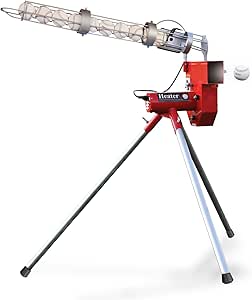 | Best Durable Workhorse for Backyards | Model: HTR6000BBC | Motor Power: 1/4 HP | Speed Range: 10–52 MPH | VIEW LATEST PRICE | See Our Full Breakdown |
| Franklin Sports MLB Electronic Baseball Pitching Machine with 6 Plastic Baseballs |  | Best Entry-Level Toss Trainer | Brand: Franklin Sports | Recommended Age: 3 years and up | Pitch Interval: 7 seconds | VIEW LATEST PRICE | See Our Full Breakdown |
| baseball pitching machine | Model | Warranty | Brand |
|---|---|---|---|
| Louisville Slugger Blue Flame | UPM 45 | 60 days against defects | Louisville Slugger |
| Electronic Baseball Pitching M | KIDS SERIES 01 | 1 year | MPOBSP |
| Heater Sports Slider Lite 360 | Slider Lite 360 | 1 year | Heater Sports |
| PowerNet Launch F-Lite Basebal | Launch F-Lite | 1-year limited warranty | PowerNet |
| Sports Attack Junior Hack Atta | Junior Hack Attack | 2 years | Sports Attack |
| Kids’ Baseball Pitching Machin | — | — | — |
| Heater Sports BLAZE Baseball a | BPM599C | 1 year | — |
| Mound Yeti Two-Wheel Baseball | YETI-2 | 2-year limited warranty | — |
| Kids’ T-Ball Set with Bat-Cont | — | — | — |
| Heater Sports Junior Baseball | — | — | — |
| DeerFable Kids Baseball Pitchi | — | — | DeerFable |
| Furlihong 636BH Dual-Wheel Bas | ZH-636BH | 180 days | — |
| Sports Tutor TriplePlay Plus B | — | 3 years | Sports Tutor |
| Heater Sports Heavy-Duty Baseb | HTR6000BBC | — | — |
| Franklin Sports MLB Electronic | — | — | Franklin Sports |
More Details on Our Top Picks
Louisville Slugger Blue Flame Pitching Machine
The Blue Flame is the most flexible choice here for practices that move between baseball, softball, and lighter training balls. Unlike the Heater Sports Slider Lite 360, it needs no outlet and weighs just 11.9 pounds, making it easier to carry between fields. Its manual operation can deliver hard-ball pitches up to 45 mph and lighter-ball pitches up to 60 mph, plus fly balls and grounders for varied drills. That flexibility comes with a tradeoff: someone must operate it, so it does not provide the steady hands-free feeding of the Slider Lite 360. The listed 60-day defect warranty is also shorter than the one-year coverage on several powered options. I’d choose it for adaptable, portable practice rather than automated batting sessions.
Pros:- Works with hard baseballs, fastpitch and slowpitch softballs, plastic balls, and select larger balls
- Throws level pitches, fly balls, and grounders for varied practice
- Requires no electricity or batteries
- At 11.9 pounds, it is easier to move than the 96-pound Junior Hack Attack
Cons:- Manual operation requires a person to operate the machine during practice
- Hard-ball speed tops out at 45 mph
- The listed defect warranty is only 60 days
Best for: Coaches and families who want one portable machine for baseball, softball, and lighter-ball drills at fields without reliable power
Not ideal for: Players seeking automatic feeding or repeated solo batting practice, since the machine is manually operated
- Brand:Louisville Slugger
- Model:UPM 45
- Power:Manual; no electricity or batteries required
- Ball speed:Up to 45 mph with hard balls; up to 60 mph with light-flight and plastic balls
- Compatible balls:Baseballs, fastpitch and slowpitch softballs, plastic and dimple balls, and select larger balls
- Pitch types:Level pitches, fly balls, and grounders
- Weight:11.9 pounds
- Dimensions:32 x 14 x 6 inches
- Warranty:60 days against defects
Our verdict“Choose the Blue Flame if portability, multiple ball types, and power-free operation matter more than automatic feeding or higher hard-ball speeds.”
Electronic Baseball Pitching Machine with Tripod and 8 Practice Balls – Adjustable Angles & Speeds, AC/Battery Powered – Youth Beginner Training
This MPOBSP youth machine is aimed at learning basic timing, not at replicating full-speed adult pitching. Its four angle settings and three speed gears offer young players some variety, while the included eight 9-inch practice balls make it a ready-to-start package. At 2.75 pounds, it is far easier to carry than the 13-pound Heater Sports Slider Lite 360, and it includes AC power with optional battery support. The main limitation is ball compatibility: it is designed for its supplied practice balls, not regulation baseballs. That makes it a more age-specific choice than the Louisville Slugger Blue Flame, which handles several ball types and fielding drills. I’d pick this for introductory reps with younger players, but skip it once they need standard-ball pitching or stronger speed.
Pros:- Four adjustable angles and three speed gears provide options for beginner drills
- Includes eight compatible 9-inch practice balls and an AC adapter
- Light 2.75-pound machine is easy to transport and set up
- Optional battery support adds flexibility when AC power is unavailable
Cons:- Only works with the supplied 9-inch practice-ball type, not regulation baseballs
- Youth-oriented performance may not challenge older or more advanced players
- AC operation or optional battery power is needed, unlike the manual Blue Flame
Best for: Families and youth coaches introducing players ages 8–14 to batting timing with a compact machine and included practice balls
Not ideal for: Older or advancing players who need regulation baseballs, stronger pitch speeds, or training that carries over directly to standard-ball play
- Brand:MPOBSP
- Model:KIDS SERIES 01
- Recommended age:8+ years
- Power:110V AC adapter with optional battery support
- Included balls:Eight 9-inch practice balls
- Adjustments:Four pitch-angle settings and three speed gears
- Product dimensions:8.5 x 6.5 x 18 inches
- Product weight:2.75 pounds
- Warranty:1 year
Our verdict“Choose this as a compact starter for young players who can train with the included practice balls and do not need regulation-ball performance.”
Heater Sports Slider Lite 360 Baseball Pitching Machine with Automatic Ball Feeder
The Slider Lite 360 is the strongest fit in this group for a player who needs a machine to feed balls without a partner. Its automatic feeder releases one of up to 12 lite baseballs every eight seconds, while the machine can throw fastballs, sliders, and curves and switch to grounders, line drives, or pop flies. That makes it more suited to varied solo practice than the youth-focused MPOBSP, though the MPOBSP is much lighter and easier to carry. The Slider Lite’s listed maximum is 80 mph from 46 feet, but it is built for lite baseballs; real baseballs are not recommended. It also needs a 110V outlet meeting the stated power requirements, so it is less flexible than the manual Blue Flame. Choose it for powered, repeatable reps, not all-ball versatility.
Pros:- Automatic 12-ball feeder supports solo practice, releasing a ball every eight seconds
- Offers fastballs, sliders, and curves, plus grounders, line drives, and pop flies
- Adjustable speed reaches up to 80 mph with compatible lite baseballs
- Includes a one-year warranty
Cons:- Real baseballs are not recommended, limiting carryover to standard-ball hitting
- Requires 110V AC power with at least 200 watts and 10 amps
- Feeder holds only 12 balls before it needs reloading
Best for: Players or coaches with access to suitable AC power who want automatic solo batting reps plus fielding practice using lite baseballs
Not ideal for: Teams needing a regulation-baseball machine or practices held where the required 110V power source is unavailable
- Brand:Heater Sports
- Model:Slider Lite 360
- Compatible balls:Lite baseballs; real baseballs are not recommended
- Maximum pitching speed:80 mph
- Pitching distance:46 feet
- Pitch types:Fastballs, sliders, and curves
- Feeder:Automatic 12-ball feeder; one ball every 8 seconds
- Power:110V AC; requires at least 200 watts and 10 amps
- Warranty:1 year
Our verdict“Choose the Slider Lite 360 for powered solo sessions and varied fielding drills if lite-ball practice and access to AC power suit your setup.”
PowerNet Launch F-Lite Baseball and Softball Pitching Machine with Practice Balls
The PowerNet Launch F-Lite earns its place by covering both baseball and softball drills in one machine, with six balls of each type included. Its four settings simulate 40–90 mph at 25 feet, and the machine can send strikes, pop flies, and line drives, giving mixed-sport teams more practice options than the baseball-only Junior Hack Attack. The tradeoff is a specific ball ecosystem: it is calibrated for PowerNet Launch F-Lite balls, and using other brands may affect performance and void the warranty. The bucket is also sold separately, so the included balls do not amount to a complete storage setup. Compared with the manual Blue Flame, this model supplies more structured speed settings but is less open to varied ball types. It suits organized F-Lite practice better than buyers seeking broad compatibility.
Pros:- Supports both baseball and softball practice
- Four settings simulate speeds from 40–90 mph at 25 feet
- Can throw strikes, pop flies, and line drives
- Includes six baseballs and six softballs
Cons:- Calibrated for PowerNet Launch F-Lite balls; other brands may affect performance and void the warranty
- Bucket is sold separately
- At 13 kg, it is substantially heavier than the 11.9-pound Blue Flame
Best for: Baseball and softball coaches who want one machine for both sports and are comfortable using the compatible Launch F-Lite balls
Not ideal for: Buyers who need broad compatibility with standard balls, want a bucket included, or prefer a lighter machine for frequent transport
- Brand:PowerNet
- Model:Launch F-Lite
- Sports:Baseball and softball
- Simulated speed:40–90 mph at 25 feet
- Speed settings:4
- Included balls:6 baseballs and 6 softballs
- Bucket:Sold separately
- Item weight:13 kg
- Warranty:1-year limited warranty
Our verdict“Choose the Launch F-Lite for baseball and softball drills if you are willing to use its specified balls and supply your own bucket.”
Sports Attack Junior Hack Attack Baseball Pitching Machine
For players who need pitches from standard baseballs, the Junior Hack Attack is the most advanced baseball-specific option in this group. It reaches up to 70 mph and offers fastballs, curveballs, sliders, split-finger pitches, and knuckleballs, while its adjustable head also supports defensive drills up to 250 feet. That makes it a stronger fit for realistic baseball development than the youth MPOBSP, which uses only its supplied practice balls, or the Slider Lite 360, which advises against real baseballs. The cost of that capability is substantial: at 96 pounds, this is not a machine for easy field-to-field carrying, and it cannot throw softballs. Its two-year warranty is longer than the listed coverage on the other four picks, but the size and single-sport compatibility make it a deliberate team or fixed-location choice.
Pros:- Throws standard baseballs, including genuine leather baseballs
- Offers multiple pitch types at speeds up to 70 mph
- Adjustable throwing head supports batting and defensive drills up to 250 feet
- Two-year warranty is longer than the coverage listed for the other machines here
Cons:- Weighs 96 pounds, making frequent transport difficult
- Baseball-only compatibility excludes softball practice
- Requires more dedicated storage and setup space than the compact youth machine
Best for: Baseball teams and serious players who want standard-ball pitch variety and defensive drills at a consistent practice location
Not ideal for: Softball players, families who need a lightweight portable machine, or buyers who want to switch among several ball types
- Brand:Sports Attack
- Model:Junior Hack Attack
- Maximum pitch speed:70 mph
- Compatible balls:Standard baseballs only
- Pitch types:Fastballs, curveballs, sliders, split-finger pitches, and knuckleballs
- Defensive drill distance:Up to 250 feet
- Item weight:96 pounds
- Item dimensions:21 x 23 x 35 inches
- Warranty:2 years
Our verdict“Choose the Junior Hack Attack if standard baseballs and varied advanced drills matter more than portability or softball compatibility.”
Kids’ Baseball Pitching Machine Set with Retractable LED Bat and 8 Glow-in-the-Dark Balls
This set is aimed at young beginners who want a playful way to practice swings, rather than a machine for serious pitch training. The bat controls one launch at a time, so children can trigger each ball themselves; its retractable design and storage bag also make the kit easier to put away than the bulkier Heater Sports Junior Baseball Pitching Machine. Eight glow-in-the-dark balls give it an after-dark play angle that the LZZAPJ T-ball set does not share, though each ball needs 5–10 seconds of light exposure before it glows. The tradeoff is limited training scope: this is a battery-powered toy-style launcher with no stated speed adjustment, not a machine for developing pitch recognition. The base also needs four AA batteries, while the bat recharges by USB.
Pros:- Bat remote lets the child trigger one ball at a time
- Includes eight glow-in-the-dark balls for low-light play
- Rechargeable bat has green, red, and blue lighting modes
- Retractable bat and storage bag make the set easier to carry and store
Cons:- Base needs four AA batteries, which are not included
- Balls need 5–10 seconds of light exposure to glow
- No pitching speed adjustment or performance figures are provided
Best for: Families with children ages 6–12 who want a compact, interactive backyard or indoor hitting game, especially for play in low light.
Not ideal for: Players seeking adjustable pitch speeds, realistic baseball flight, or structured practice for competitive teams.
- Recommended age:6–12 years
- Ball diameter:3.15 in (8 cm)
- Approximate launch height:3.5–4.3 ft
- Bat length:13.78 in retracted / 22.44 in extended
- Base power:4 AA batteries (not included)
- Bat power:Built-in rechargeable lithium battery
- Included balls:8 glow-in-the-dark balls
- Included accessories:USB charging cable, storage bag, user manual
Our verdict“Choose this for a young child who values interactive, glow-in-the-dark play over realistic pitching practice.”
Heater Sports BLAZE Baseball and Softball Pitching Machine, Up to 70 MPH
The BLAZE earns its place for practices that need to switch between baseball and softball and between ground balls, strikes, line drives, and pop flies. Its 10–70 mph range gives coaches room to scale the challenge, while the 90-degree angle adjustment adds more drill variety than the Heater Sports Junior Baseball Pitching Machine, whose listed range tops out at 48 mph and is baseball-focused. Compared with the Mound Yeti, the BLAZE has a lower stated maximum speed, but it is also substantially lighter at 55 pounds versus 102 pounds. That is still a heavy machine to move, so it suits a dedicated practice space better than frequent solo transport. Its broad ball compatibility is useful, but the supplied information does not specify a feeder or included balls.
Pros:- Accepts lite and real baseballs as well as lite and real softballs
- 10–70 mph speed range supports different practice levels
- 90-degree pitch-angle adjustment enables varied fielding and hitting drills
- One-year warranty is specified
Cons:- At 55 pounds, it may be difficult for one person to move regularly
- Its 70 mph ceiling is below the Mound Yeti’s stated 95 mph maximum
- Product details do not specify a feeder or included balls
Best for: Coaches or households running both baseball and softball sessions who want adjustable speed and pitch angle in one machine.
Not ideal for: Players who need a lightweight machine for frequent transport, or buyers seeking a stated automatic feeder and included practice balls.
- Model:BPM599C
- Ball types:Lite and real baseballs; lite and real softballs
- Speed range:10–70 mph
- Pitch angle:90-degree adjustment
- Item dimensions:19 × 19 × 21 inches
- Item weight:55 pounds
- Warranty:1 year
Our verdict“Pick the BLAZE for adaptable baseball-and-softball sessions if its 55-pound frame can stay near your practice area.”
Mound Yeti Two-Wheel Baseball and Softball Pitching Machine
With a stated ceiling of 95 mph, two ball chutes, and support for breaking balls, fastballs, and fielding practice balls, the Mound Yeti is the most demanding team-practice choice in this group. Its two chutes let coaches prepare baseballs and softballs for alternating use, while separate release heights—48 inches for baseball and 30 inches for softball—help match each sport. The Heater Sports BLAZE is the more manageable alternative at 55 pounds and offers a wider low-speed starting point; the Yeti reaches higher speeds but weighs 102 pounds, making regular transport a serious consideration despite the included transport kit. The listing also has a naming inconsistency: its title says two-wheel, while the description mentions single-wheel and the specifications identify two chutes, not a wheel count. I would confirm the machine configuration before ordering.
Pros:- 45–95 mph range accommodates a broad range of practice demands
- Two chutes support use with baseballs and softballs
- Described as capable of fastballs, breaking balls, and fielding practice balls
- Includes transport kit and two leg sets
Cons:- At 102 pounds, it is difficult to move despite the transport kit
- The title and description conflict over whether the machine is two-wheel or single-wheel
- Higher speed range may be unnecessary for beginners
Best for: School or club coaches who need a high-speed machine for baseball and softball drills and can keep a heavy unit at a stable practice site.
Not ideal for: Families or individual players who need a lightweight, easy-to-store machine, or buyers who require clear confirmation of the wheel configuration.
- Model:YETI-2
- Speed range:45–95 mph
- Baseball release height:48 inches
- Softball release height:30 inches
- Ball chutes:2
- Weight:102 pounds
- Material:Metal
- Warranty:2-year limited warranty
Our verdict“Choose the Yeti for advanced mixed-sport team drills when high speed matters more than easy handling.”
Kids’ T-Ball Set with Bat-Controlled Pitching Machine
This set is best understood as a starter T-ball game, not a smaller version of an adult pitching machine. The bat-mounted remote triggers the popper, which launches a plastic ball about every three seconds at a stated height of 3.9–4.3 feet. That gives young children time to reset between swings, while the five-ball capacity means fewer pauses to reload than a single-ball launcher such as the Mintorisle LED set. In return, it offers fewer balls and no glow-in-the-dark play feature. Its listed age range runs from 36 months to 12 years, but the small plastic balls and toy-style setup are more fitting for beginners than older players seeking realistic batting practice. Battery details are inconsistent: the listing mentions two AA batteries for the remote and also six AA batteries, so I would verify the requirement before use.
Pros:- Bat-mounted remote lets the batter control launches
- Five-ball capacity allows several swings before reloading
- Telescoping bat adjusts from 13.4 to 22.4 inches
- Launches at a stated height of 3.9–4.3 feet
Cons:- Battery information conflicts between two AA and six AA requirements
- Batteries are not included
- Uses plastic balls and does not list adjustable pitching speed
Best for: Parents introducing preschool and elementary-age children to batting with a simple, bat-controlled launcher and plastic balls.
Not ideal for: Older players or families seeking realistic baseballs, adjustable pitching speeds, or clear battery requirements before purchase.
- Recommended age:36 months to 12 years
- Bat length:13.4–22.4 inches
- Launch height:3.9–4.3 feet
- Ball capacity:5 plastic baseballs
- Launch rate:About 1 ball every 3 seconds
- Battery information:Product details list 2 AA batteries for the bat remote and also 6 AA batteries required
- Material:Plastic
- Item weight:14.4 ounces
Our verdict“Choose this set for a young beginner who needs a simple T-ball launcher, provided you confirm its battery needs.”
Heater Sports Junior Baseball Pitching Machine
The Junior is a step up from the children’s bat-controlled poppers in this roundup: its 1/4-horsepower motor and automatic feeder are aimed at repeated baseball batting practice, not novelty play. A 12-ball capacity and delivery every 10–12 seconds let a batter take several swings without a helper feeding each pitch, while the 15–48 mph range supports a gentler start than the Mound Yeti’s 45–95 mph range. The Junior is also much lighter than that 102-pound machine at 23.5 pounds, and its tripod stand and air-filled tires suit moving it around a practice area. The tradeoffs are a 12-ball feeder that needs refilling and inconsistent listed figures: the interval varies between 10 and 12 seconds, and the maximum speed is reported as both 46 and 48 mph. It is baseball-focused rather than a stated softball option.
Pros:- Adjustable 15–48 mph pitching range
- Automatic feeder holds 12 baseballs for hands-free practice
- At 23.5 pounds, it is lighter than the Mound Yeti
- Tripod stand and air-filled tires support portability
Cons:- The 12-ball feeder requires regular reloading during longer sessions
- Feeder interval is listed as 10–12 seconds
- Maximum speed is inconsistent in the product details, listed as 46 or 48 mph
Best for: Families and youth coaches who want a portable, motorized machine for recurring baseball practice without moving to a heavy high-speed unit.
Not ideal for: Teams needing softball compatibility, a larger feeder, or a confirmed maximum speed for tightly planned drills.
- Motor:1/4 horsepower DC
- Pitching speed:15–48 mph; product details also list 46 mph as the maximum
- Feeder capacity:12 baseballs
- Feeder interval:Every 10–12 seconds
- Weight:23.5 pounds
- Dimensions:38 × 38 × 38 inches
- Stand:Tripod stand
- Mobility:Air-filled tires
Our verdict“Pick the Junior for portable, hands-free youth baseball practice if a 12-ball feeder and the listed speed inconsistencies are acceptable.”
DeerFable Kids Baseball Pitching Machine with 6-Ball Feeder
This machine stands out for its one-click operation, allowing children aged 3–12 to start practice without adult intervention. Unlike the Franklin Sports MLB Electronic, which requires a fixed 7-second wait, this model lets kids control the pace via a simple button, fostering autonomy. The 6-ball auto feeder reduces constant reloading, a significant upgrade over smaller capacity options. However, the soft hollow PP balls lack the weight and seam feel of regulation baseballs, meaning it is not suitable for older players developing hand-eye coordination for real games. It is a toy-first tool, not a training aid.
Pros:- One-click button enables independent play for young children
- Compact 6-ball feeder minimizes interruptions during short sessions
- Included telescopic bat adjusts from 15 to 24 inches for growth
- Lightweight design allows easy storage in the provided carry bag
Cons:- Hollow plastic balls do not mimic the flight or feel of real baseballs
- Limited to two pitching modes, offering little variety for skill development
Best for: Parents seeking a safe, self-contained unit for very young children to practice hand-eye coordination indoors.
Not ideal for: Players aged 10 and up who need realistic ball weight and speed for competitive training.
- Brand:DeerFable
- Age Range:3–12 years
- Feeder Capacity:6 balls
- Pitching Modes:2
- Bat Length:15–24 inches, adjustable
- Ball Material:Hollow PP
- Safety Standards:CPC and ASTM F963
Our verdict“A solid entry-level choice for toddlers and young kids who need safe, independent practice with toy-grade equipment.”
Furlihong 636BH Dual-Wheel Baseball Pitching Machine
The Furlihong 636BH bridges the gap between toy-grade machines and professional equipment. With speeds reaching 68 mph, it outperforms the Heater Sports Heavy-Duty (max 52 mph), making it viable for high school and youth league training. The adjustable launch interval allows coaches to simulate game-like timing rather than just rapid-fire hitting. However, it relies on AC power, limiting setup locations to areas with outlets. At nearly 40 pounds, it is portable but less convenient than battery-operated alternatives like the Sports Tutor TriplePlay, which offers cord-free flexibility.
Pros:- Speed range of 40–68 mph covers most youth and adult skill levels
- Adjustable pitch angle and launch interval simulate varied game scenarios
- Sturdy iron construction provides stability during high-speed pitches
- Includes ball tracks and training balls for immediate use
Cons:- Requires a nearby AC power source, restricting portability
- Assembly of ball tracks adds setup time compared to integrated feeders
Best for: Youth coaches and serious players needing realistic speeds up to 68 mph for batting practice.
Not ideal for: Users needing cord-free practice in remote fields, as it requires a standard AC outlet.
- Model:ZH-636BH
- Speed Range:40–68 mph
- Power:AC-powered
- Material:Iron
- Package Weight:17.58 kg (approx. 38.7 lbs)
- Included Components:4 ball tracks, dust cover, 3 training balls
- Warranty:180 days
Our verdict“A powerful, durable machine for committed youth players who have access to power outlets.”
Sports Tutor TriplePlay Plus Baseball Pitching Machine
This three-wheel machine offers eight pitch types, including flyballs and groundballs, far exceeding the single-mode capabilities of the Franklin Sports MLB or the basic modes of the DeerFable. The 90 mph top speed and digital readout provide professional-grade feedback, while the optional battery pack allows for four hours of cord-free use. However, at 140 pounds, it is cumbersome to transport without its wheels. Compared to the lighter Furlihong 636BH, this model sacrifices portability for versatility and power, making it a stationary investment for teams rather than a portable tool for individual families.
Pros:- Eight selectable pitch types include flyballs and groundballs for fielding practice
- Optional battery pack enables up to four hours of cord-free operation
- Digital speed display ensures precise pitch calibration from 40–90 mph
- Three-year warranty reflects confidence in long-term durability
Cons:- Heavy 140-pound weight makes moving it difficult without assistance
- Battery pack requires overnight charging, limiting back-to-back usage
Best for: Travel teams and schools needing advanced pitch variety and fielding drills in various locations.
Not ideal for: Home users with limited storage space or those who cannot handle 140-pound equipment.
- Brand:Sports Tutor
- Max Pitch Speed:90 mph
- Pitch Types:8
- Power:AC/DC (Battery optional)
- Item Weight:140 pounds
- Warranty:3 years
- Country of Manufacture:USA
Our verdict“The best choice for organized teams requiring versatile, high-speed pitching away from power outlets.”
Heater Sports Heavy-Duty Baseball Pitching Machine with Bonus Ball Feeder
Built with an all-metal housing, this Heater Sports model feels more robust than the plastic-bodied Franklin Sports MLB. Its 12-ball automatic feeder ensures continuous practice, a clear advantage over the 6-ball capacity of the DeerFable. While the speed range tops out at 52 mph, this is sufficient for beginners and intermediate hitters, though it falls short of the Furlihong 636BH’s 68 mph ceiling. The lack of battery power means it is tethered to an outlet, but the rugged construction suggests it can withstand years of outdoor abuse better than lighter competitors.
Pros:- All-metal construction offers superior durability compared to plastic models
- 12-ball feeder allows for longer practice sessions without reloading
- Adjustable tilt enables practice for grounders and pop-ups
- Wide speed range (10–52 MPH) accommodates varying skill levels
Cons:- Heavy 42.7-pound weight makes it difficult to relocate frequently
- Speed control lacks fine granularity, jumping in coarse increments
Best for: Families wanting a durable, low-maintenance machine for backyard batting practice with young to teen players.
Not ideal for: Advanced players needing speeds above 52 mph or those requiring cord-free portability.
- Model:HTR6000BBC
- Motor Power:1/4 HP
- Speed Range:10–52 MPH
- Feeder Capacity:12 balls
- Item Weight:42.7 pounds
- Power Source:Standard AC outlet
- Recommended Ages:8 years to adult
Our verdict“A reliable, heavy-duty option for backyard use where durability and continuous feeding matter most.”
Franklin Sports MLB Electronic Baseball Pitching Machine with 6 Plastic Baseballs
This compact unit serves as a basic toss trainer rather than a true pitching machine. The flashing light signal helps young hitters anticipate the pitch, a feature absent in the DeerFable. However, the fixed 7-second interval and low speed make it unsuitable for developing timing skills required in game play. Unlike the Heater Sports Heavy-Duty, which offers adjustable speeds and a larger feeder, this model is strictly for introduction to the sport. It is ideal for toddlers learning to track a moving object, but players seeking realistic batting practice will quickly outgrow its limitations.
Pros:- Flashing light cue helps beginners anticipate the pitch timing
- Small footprint fits easily in tight indoor spaces or garages
- Includes six plastic balls to get started immediately
- Very lightweight and easy for small children to handle
Cons:- Fixed 7-second pitch interval does not simulate game-speed timing
- Must use only included plastic balls, which wear out and are not replaceable in bulk
Best for: Toddlers and very young children learning to track and hit a stationary or slow-moving ball.
Not ideal for: Players aged 6+ who need speed variation and realistic pitch intervals for skill development.
- Brand:Franklin Sports
- Recommended Age:3 years and up
- Pitch Interval:7 seconds
- Adjustable Angles:3
- Included Balls:6 plastic baseballs
- Assembled Dimensions:7.75 × 9.5 × 9.875 inches
- Material:Plastic
Our verdict“A simple, affordable intro tool for toddlers to learn tracking, not for serious batting practice.”

How We Picked
I evaluated these machines based on pitch consistency, speed range, and ease of use. A machine that throws at 70 mph one minute and 65 mph the next is useless for serious batting practice, so I prioritized models with stable motor controls. I also looked at portability and setup time, because a machine that takes twenty minutes to assemble will rarely get used. Features like automatic ball feeders and the ability to throw breaking balls were weighted heavily for advanced players, while durability and safety features were prioritized for youth-focused models.
The ranking reflects a balance between performance and value. I excluded machines that lacked basic safety guards or had poor build quality that suggested frequent jamming. I also considered the availability of replacement parts and customer support reputation, as pitching machines are mechanical devices that will eventually need maintenance. This ensures that every pick is not just a good product on paper, but a reliable training tool for the long term.
Factors to Consider When Choosing Baseball Pitching Machine
Selecting a pitching machine is not just about speed; it is about matching the machine’s capabilities to the player’s skill level and the available practice environment. Here are the critical factors to weigh before making a purchase.
Single-Wheel vs. Dual-Wheel Mechanisms
Most entry-level machines use a single-wheel mechanism, which is simpler, lighter, and cheaper. These are ideal for throwing straight pitches at consistent speeds, making them perfect for youth leagues or beginners learning hand-eye coordination. However, they struggle to create realistic spin on breaking balls. Dual-wheel machines, on the other hand, use two wheels spinning at different speeds to generate topspin, backspin, or sidespin. This allows for curveballs, sliders, and fastballs that mimic real game action. If you are training a high school or adult player, a dual-wheel system is almost mandatory for effective batting practice. The tradeoff is weight and cost; dual-wheel units are heavier, harder to transport, and require more precise calibration.
Pitch Speed Range and Control
Check the speed range carefully. A machine that only throws up to 40 mph is useless for a 14-year-old trying to practice against a 60 mph pitch. Look for models with a wide adjustable range, ideally from 30 mph to 70+ mph, to accommodate different skill levels. More importantly, look for fine-tuning dials rather than just preset buttons. Being able to nudge the speed by 1-2 mph helps in progressive training, allowing the batter to gradually adjust to faster pitches. Poor speed control leads to inconsistent contact, which can build bad habits. Always verify if the speed rating is for a specific ball type, as plastic balls may throw slower than leather-covered ones.
Power Source: AC vs. Battery
AC-powered machines offer consistent power and speed, making them the standard for backyard or indoor training where an outlet is available. They are generally more powerful and maintain speed better over long sessions. Battery-powered machines offer the freedom to set up at a local park or field without an extension cord, which is a huge convenience. However, batteries add weight, require charging time, and often lose power as they drain, causing pitch speed to drop mid-practice. If you plan to practice at a public field, check local regulations regarding equipment and noise. For most home users, an AC-powered unit with a long extension cord is the more reliable and cost-effective choice.
Ball Feed Systems and Capacity
Manually feeding balls one by one is tedious and interrupts the batter’s rhythm. Machines with automatic ball feeders hold anywhere from 15 to 200 balls and dispense them at set intervals. This feature is a game-changer for solo practice, allowing the batter to focus entirely on hitting rather than waiting. Manual feed machines are lighter and cheaper but require a partner to toss balls into the machine. Consider how many balls you want to practice with before restocking. A larger hopper means fewer breaks, but it also means the machine is bulkier and harder to store. For families with multiple kids, a high-capacity feeder is worth the extra investment.
Portability and Storage Footprint
Assess where you will store the machine. Many dual-wheel machines weigh over 50 pounds and have awkward shapes that do not fit in a standard garage shelf. Look for features like wheels, foldable frames, or compact designs if you need to move the machine frequently. Some models, like the PowerNet Launch F-Lite, are designed to be lightweight and easily tucked away. If you have limited space, a vertical storage design or a machine that disassembles into smaller parts is preferable. Remember that a machine that is hard to move will likely sit unused. Check the dimensions against your storage space before buying, especially if you live in an apartment or have a small shed.
Frequently Asked Questions
Can I use tennis balls in a baseball pitching machine?
Some machines are designed to handle tennis balls, but you must check the manufacturer’s specifications first. Tennis balls are smaller and have a different surface texture than baseballs, which can cause jamming or damage to the wheels if the machine is not calibrated for them. Using the wrong ball type can also alter the pitch speed and accuracy, rendering the practice session ineffective. Many dual-wheel machines have adjustable gaps that can accommodate tennis balls, but single-wheel machines are often strictly for baseballs or softballs. Always use the ball type recommended by the manufacturer to maintain the warranty and ensure safe operation.
How often do I need to replace the pitching machine wheels?
The lifespan of the wheels depends on usage frequency and ball type. Leather-covered baseballs are more abrasive and will wear down rubber wheels faster than smooth plastic or tennis balls. For a typical home user practicing twice a week, you might get 2-3 years out of a set of wheels before noticing a decline in grip and consistency. Signs of wear include slippage, inconsistent speeds, or visible cracking on the wheel surface. Replacement wheels are usually inexpensive and easy to install, but availability varies by brand. Check if replacement parts are readily available before purchasing a lesser-known brand.
Is it safe to use a pitching machine indoors?
Yes, but you must take strict safety precautions. Always use plastic or foam balls indoors to prevent damage to walls, windows, and furniture. Ensure there is a large, clear area behind the netting or backstop to prevent balls from ricocheting back toward the batter or the machine. Indoor spaces often have lower ceilings, which can interfere with the arc of high-speed pitches. Make sure the machine is on a stable, non-slip surface to prevent it from walking or tipping over during operation. Never operate a machine in a space where people can accidentally walk into the flight path of the ball.
What is the difference between a pitching machine and a J-net?
A J-net is a passive target that hangs from a frame; the batter hits the ball into it, and the ball drops back down for immediate reuse. It does not throw pitches, so it is only useful for swing mechanics and hand-eye coordination with self-toss or coach toss. A pitching machine actively throws balls at the batter, simulating game-like conditions, speed, and timing. For advanced training, a pitching machine is superior because it forces the batter to read the ball and adjust timing dynamically. Many players use both: a J-net for warm-ups and mechanical drills, and a pitching machine for live batting practice.
Do pitching machines require regular maintenance?
Yes, regular maintenance is required to keep the machine running smoothly. You should clean the wheels regularly to remove dirt, grass, and ball residue, which can reduce grip and cause slippage. Check all bolts and screws for tightness, as vibration from operation can loosen them over time. Lubricate moving parts like the angle adjustment knobs and wheel bearings if specified in the manual. Inspect the electrical cord for damage if you use an AC model. Neglecting maintenance can lead to jams, motor burnout, or inconsistent pitch speeds, significantly shortening the machine’s lifespan.
Conclusion
Choosing the right baseball pitching machine comes down to matching the technology to the player’s stage. For the best overall performance and versatility, the Heater Sports Slider Lite 360 is the clear winner, offering automatic feeding and realistic pitch movement that suits teens and adults. If you are on a tight budget and need a simple, portable solution for younger kids, the Franklin Sports MLB Electronic Baseball Pitching Machine is a solid starter option, provided you accept the limitations of fixed speed and straight pitches. For serious amateur players who need game-like speed and variety, the Sports Attack Junior Hack Attack or Heater Sports Heavy-Duty models are worth the premium price for their durability and advanced features. Ultimately, invest in the machine that matches your current skill level, but consider future growth if you plan to use it for multiple years.