
Your tailgate setup’s power needs depend on the devices you’ll run and how long you’ll use them. Calculate each device’s wattage and operational hours to find total energy consumption in watt-hours. Keep in mind, a small sound system or charging station may only need a few hundred watt-hours, but larger appliances like mini-fridges require more. Combining solar panels and batteries helps make certain of reliable power, and you’ll see how to plan effectively as you explore further.
Key Takeaways
- Identify all devices and their wattage to determine total energy consumption for the tailgate setup.
- Calculate daily power needs by multiplying device wattage by planned usage hours to estimate total watt-hours.
- Use this total to select appropriately sized solar panels and batteries for reliable, off-grid power.
- Incorporate backup battery capacity (600-700 Wh) to ensure continuous power during cloudy days or extended use.
- Prioritize efficient, high-capacity batteries and solar panels to meet energy demands and maintain setup performance.
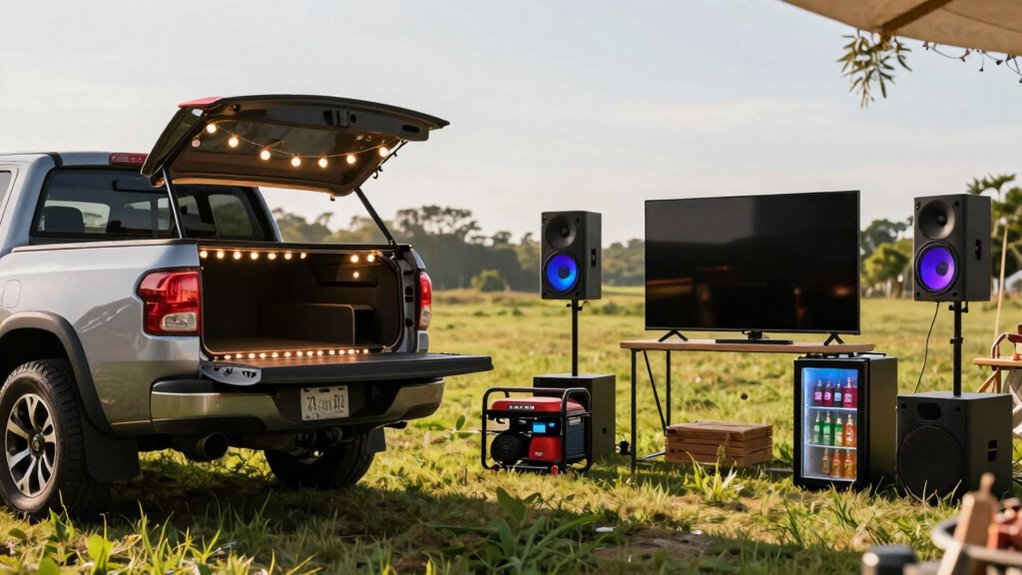
When planning your next tailgate party, understanding your power needs is vital to keep everything running smoothly. Whether you’re grilling, playing music, charging devices, or running small appliances, knowing how much power you’ll require helps you avoid surprises and guarantees your setup is reliable. The key is to assess what devices you’ll be powering and estimate their energy consumption. This way, you can determine the appropriate solar panels and battery capacity to keep your tailgate energized throughout the event.
Start by making a list of all the electronic devices you plan to use. For example, if you want to run a portable fridge, a sound system, and charge smartphones or tablets, note their wattage and how long you’ll need each device to operate. Most devices will have wattage ratings printed on them, making it easier to calculate total power requirements. Once you have these numbers, you can estimate your total energy consumption in watt-hours (Wh). For instance, if your fridge consumes 50 watts and runs for 8 hours, it requires 400 Wh of energy. Add in the energy needed for your sound system and charging stations to find your overall power needs.
List your devices, note wattage and duration, then calculate total watt-hours needed for a reliable tailgate setup.
Next, consider how to meet these energy demands with solar panels and a suitable battery system. Solar panels are an eco-friendly, quiet way to generate power during the event, but their size and number depend on your total energy requirement. Solar panels are a popular renewable energy source for outdoor setups, and a few portable solar panels with a combined capacity of around 100-200 watts can suffice, especially if you plan to be outdoors during daylight hours. These panels can recharge your batteries throughout the day, ensuring a steady supply of power.
Battery capacity plays a vital role in your setup. You want a battery bank that can store enough energy to run your devices when the sun isn’t shining or during cloudy weather. If your total energy consumption is roughly 500 Wh, aim for a battery capacity of at least 600-700 Wh to account for inefficiencies and backup. Lithium-ion batteries are popular for their high capacity and longevity, making them a wise choice for tailgating.

Renogy 200W Portable Solar Panel, IP65 Waterproof Foldable Solar Panel Power Backup, Solar Charger for Power Station RV Camping Off Grid
- High Efficiency: 25% conversion with advanced cell tech
- Lightweight & Compact: Only 13.89 lbs with foldable design
- Magnetic Closure: Easy setup and storage with magnetic handle
As an affiliate, we earn on qualifying purchases.
As an affiliate, we earn on qualifying purchases.
Frequently Asked Questions
Can a Tailgate Setup Run on Solar Power Alone?
Yes, a tailgate setup can run on solar power alone if you have enough solar panel efficiency and battery capacity. You’ll need high-quality, efficient panels to generate sufficient energy during daylight, and a large enough battery to store power for use when the sun isn’t shining. Properly calculating your energy needs guarantees your solar system keeps your tailgate setup running smoothly without relying on external power sources.
How Long Can a Tailgate Power Station Last During a Party?
During a party, your tailgate power station can last several hours if you focus on battery capacity and power efficiency. The longer you conserve energy, the longer the station sustains your devices, speaker, and lights. You optimize your experience by minimizing unnecessary power use, ensuring your battery capacity lasts through the festivities. Keep devices efficient, limit high-power draws, and enjoy your party without worrying about running out of juice too soon.
Are There Weight Limits for Portable Power Sources on Tailgates?
Yes, there are weight limits for portable power sources on tailgates, mainly due to safety and vehicle regulations. You should consider the battery capacity to make certain your power source isn’t too heavy for your setup. Always check local power regulations and vehicle weight limits before loading a portable power source. Overloading can lead to safety hazards and potential damage, so stay within recommended limits for a smooth, safe tailgate experience.
What’s the Best Battery Type for High-Demand Tailgate Equipment?
You need a lithium-ion battery for your high-demand tailgate equipment because it packs the most power with incredible battery capacity and lightweight design. It handles massive loads effortlessly and charges quickly with versatile options like fast chargers or solar panels. This setup guarantees your gear stays powered all game long, making your tailgate legendary. Lithium-ion batteries are the ultimate choice to keep your party unstoppable!
How Do Weather Conditions Affect Tailgate Power Reliability?
Weather conditions can substantially impact your tailgate power reliability. Wind resistance may cause power fluctuations or disconnections, especially if your setup isn’t securely anchored. Temperature impacts your battery’s performance, with cold weather reducing capacity and efficiency, while excessive heat can shorten battery life. To guarantee consistent power, choose weather-resistant equipment, insulate batteries in cold climates, and secure all components against strong winds.
Conclusion
Understanding your tailgate setup’s power needs is like tuning a finely crafted instrument—you want just the right amount of energy to hit the perfect note. By evaluating your equipment and considering future upgrades, you guarantee your tailgate remains a symphony of functionality without overloading the system. Remember, a well-powered tailgate isn’t just a convenience; it’s the heartbeat of your outdoor gatherings, pulsing with the right energy to keep your events lively and seamless.