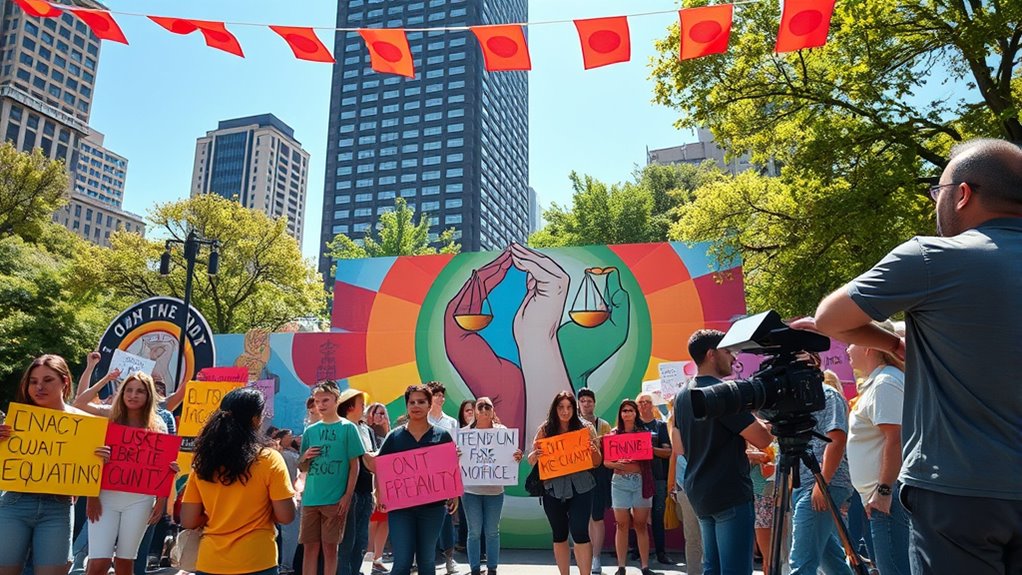

To measure the impact of social justice initiatives, you should use a mix of quantitative data, such as economic mobility and healthcare access, along with community feedback that offers real-world insights. Comparing outcomes against benchmarks helps you see progress, while engaging communities reveals barriers or unintended effects. Combining these approaches guarantees you understand both short-term results and long-term societal changes. Keep exploring to discover how thorough evaluation can shape even more effective strategies.
Key Takeaways
- Use measurable indicators like economic mobility, education access, and healthcare equity to evaluate initiative outcomes.
- Compare data before and after policies to assess changes and impact.
- Engage community members to gather qualitative insights on real-world effects.
- Combine quantitative metrics with community feedback for a comprehensive impact assessment.
- Focus on long-term societal shifts and continuous policy refinement for sustained justice.
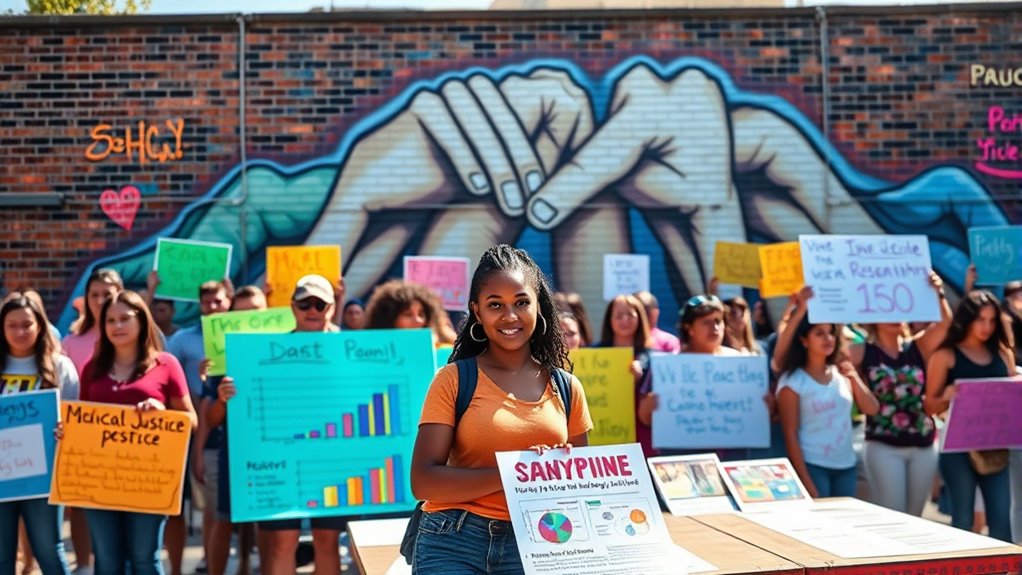
Social justice initiatives aim to address inequality and promote fairness across various communities, and their impact can be seen in both immediate improvements and long-term societal shifts. To truly understand whether these efforts succeed, you need to focus on effective measurement strategies, starting with policy evaluation. Policy evaluation allows you to assess the specific programs and interventions put into place, determining their effectiveness in reducing disparities or promoting inclusion. By systematically analyzing data before and after a policy’s implementation, you can identify whether the intended outcomes are achieved. This process involves examining various indicators—such as economic mobility, access to education, or healthcare equity—and comparing them against benchmarks or control groups. Through rigorous policy evaluation, you gain insight into which initiatives work, which need modification, and where resources should be targeted for maximum impact.
Equally important is community engagement, which serves as a crucial tool for measuring the real-world effects of social justice initiatives. When you involve community members in the evaluation process, you get a clearer picture of how policies are experienced on the ground. Community engagement fosters trust, ensuring that affected populations contribute their perspectives and insights, which often reveal barriers or unintended consequences that data alone might miss. By listening to community voices, you can adapt strategies to better meet local needs and ensure that initiatives are genuinely inclusive. Furthermore, ongoing engagement helps sustain momentum, making it easier to track progress over time and identify shifts in community sentiment or well-being. Incorporating mindfulness practices into community evaluation can also enhance empathetic understanding and foster more meaningful dialogue.
Combining policy evaluation with active community engagement offers an all-encompassing approach to measuring impact. While policy evaluation provides quantitative data on outcomes, community engagement offers qualitative insights into lived experiences. This dual approach helps you understand not only whether a policy works but also how it affects people’s daily lives. It allows you to identify gaps between policy intentions and actual impacts, guiding adjustments for greater effectiveness. Additionally, engaging communities continuously encourages transparency and accountability, making it clear that the initiatives are responsive to those they aim to serve.
Ultimately, by prioritizing both policy evaluation and community engagement, you build a more accurate, inclusive picture of social justice initiatives’ impact. This balanced approach ensures that you’re not just measuring numbers but also capturing the human stories behind those numbers. It helps you refine strategies, allocate resources wisely, and foster long-term societal change rooted in fairness and equity.

Know Justice Know Peace: A Transformative Journey of Social Justice, Anti-Racism, and Healing through the Power of the Enneagram
As an affiliate, we earn on qualifying purchases.
As an affiliate, we earn on qualifying purchases.
Frequently Asked Questions
How Do We Define Success in Social Justice Initiatives?
You define success in social justice initiatives by analyzing qualitative metrics and long-term outcomes. You look for meaningful changes in communities, such as increased equity, empowerment, and inclusivity. Success isn’t just immediate results; it’s sustained progress over time. You measure how well initiatives foster lasting social change, improve lives, and create equitable opportunities, ensuring your efforts lead to genuine, lasting impact rather than temporary fixes.
What Are Common Challenges in Measuring Impact?
You might face hurdles when trying to measure impact, as the true effects often hide behind complex, unseen layers. Quantitative metrics can fall short, missing nuanced shifts in community well-being. Evaluation frameworks help, but they can be rigid or overlook cultural contexts. These challenges make it hard to capture genuine progress, leaving you questioning if your efforts truly resonate or just scratch the surface.
How Can Biases Affect Impact Evaluation?
Biases like implicit bias and evaluation bias can distort your impact assessment. Implicit bias influences how you interpret data, making you overlook certain outcomes or overemphasize others. Evaluation bias occurs when your expectations shape results, leading you to see positive impacts where they might not exist. To get an accurate picture, you need to recognize these biases, implement blind analysis, and use diverse evaluation methods.
What Role Do Community Voices Play in Assessment?
Your community voices are the heartbeat of impact assessment, providing insights that no data alone can capture. By actively engaging in community participation and gathering stakeholder feedback, you guarantee evaluations reflect real experiences and needs. These voices shape more effective, equitable social justice initiatives, preventing the process from becoming an echo chamber. Your involvement transforms assessments into powerful tools for meaningful change, proving that collective insight is the true engine of progress.
How Sustainable Are the Positive Changes From These Initiatives?
You’ll find that the positive changes from social justice initiatives can be quite sustainable when they lead to long-term effects and cultural shifts. If these efforts foster ongoing community engagement and systemic change, they’re more likely to persist. However, without continued support or adaptation, their sustainability may diminish. So, actively nurturing these initiatives guarantees their impact remains strong, shaping lasting cultural shifts that benefit future generations.
Conclusion
You see, measuring social justice initiatives is like charting a course through uncharted waters—you may not see the full horizon, but each step reveals progress. By tracking their impact, you turn the tide of change, transforming hope into tangible results. Remember, even small waves can carve deep canyons over time. So, keep measuring, keep pushing forward, and let your efforts be the compass that guides us toward a more equitable future.